4 Ways Smart Mirrors Are Changing Morning Routines
There’s a particular kind of stress that lives in the morning. Not the dramatic, life-altering kind the quiet, cumulative kind. The alarm goes off and already the clock is running. You’re half-asleep, reaching for your phone, skimming weather apps and news headlines while trying to remember if you scheduled that 9 a.m. call. You brush your teeth staring into a mirror that tells you absolutely nothing useful. Then you’re out the door, slightly underdressed for the cold, running three minutes late, and the day has already started with a deficit.
Smart mirrors aren’t solving world hunger. But they are quietly dismantling this particular kind of friction and the more you understand what they actually do, the harder it gets to dismiss them as a gimmick.
They Turn Dead Time Into Functional Time
Here’s the honest truth about your bathroom mirror: you spend somewhere between 10 and 20 minutes in front of it every single morning, and most of that time your brain is essentially idle. You’re going through physical motions brushing, washing, applying while your mind drifts or, worse, scrolls through your phone balanced precariously on the sink.
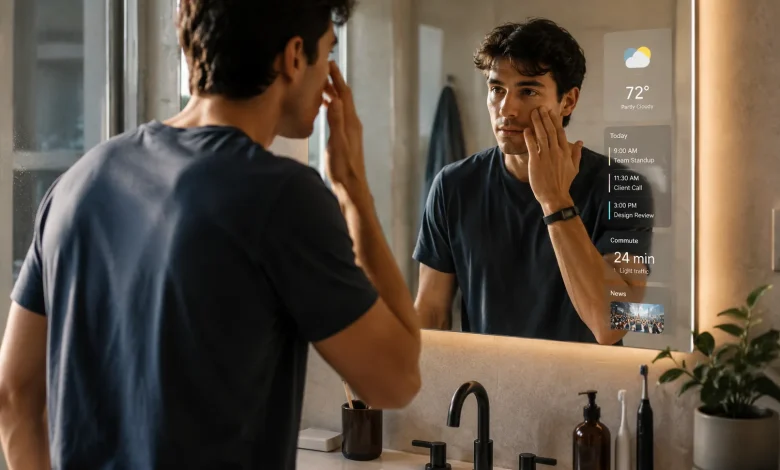
Smart mirrors redirect that idle bandwidth. A display embedded in the mirror surface can surface your calendar, the day’s weather forecast, traffic conditions on your commute route, and a quick news digest all without requiring you to pick up a device. Your hands stay free. Your attention doesn’t fragment across multiple screens. The information comes to you, layered transparently over your reflection, rather than demanding you go find it.
This might sound like a minor convenience, but the psychology here is meaningful. Cognitive researchers have long documented the cost of task-switching every time you shift focus from one activity to another, there’s a small but real mental overhead. Checking your phone while getting ready multiplies those switches. A smart mirror collapses several information-gathering tasks into a single, ambient experience. You absorb what you need while doing what you were already doing.
Some higher-end models from brands like HiMirror and Séura allow users to customize exactly which widgets and data streams appear. Others integrate with smart home ecosystems pulling from Google Home or Amazon Alexa so the mirror becomes one node in a broader connected environment rather than an isolated gadget.
They’re Changing How People Think About Skin and Health
The cosmetic industry has spent decades selling the idea that you need more products. Smart mirrors are, somewhat ironically, starting to shift that narrative toward something more diagnostic.
Several smart mirror platforms now include built-in skin analysis technology. Using a combination of high-resolution cameras and AI-driven image processing, these mirrors can assess hydration levels, detect early signs of sun damage, track changes in complexion over time, and even flag irregularities that a casual glance would miss. The HiMirror Plus, for instance, markets itself explicitly as a “beauty advisor,” generating detailed skin reports and adjusting product recommendations based on what the camera actually detects rather than what a marketing team decided to push.
The implications are more interesting than they first appear. When your skincare routine is driven by real-time feedback rather than product packaging, you start to notice actual cause and effect. You see that your skin responds differently after poor sleep. You notice that a product you’ve been using for six months hasn’t done what it promised. You start treating your morning skincare routine less like a ritual and more like a practice something that evolves based on results.
There’s also a growing category of smart mirrors targeting fitness and wellness beyond skincare. Some models integrate with fitness trackers and health apps to display metrics like resting heart rate, sleep quality scores, and hydration reminders. The bathroom mirror, historically the site of purely cosmetic self-appraisal, becomes a daily health checkpoint.
Critics raise fair questions about privacy here. Skin analysis means your mirror is, in effect, processing biometric data on a recurring basis. Where that data goes, how it’s stored, whether it’s shared with third parties these are questions consumers should be asking before they invest, and questions the industry has been slow to answer with satisfying clarity.
They’re Redefining the Fitness Space at Home
The morning workout has always had a dropout problem. Gym memberships go unused. Fitness apps get abandoned after two weeks. The barrier isn’t usually motivation it’s transition cost. Getting dressed, driving somewhere, finding parking, waiting for equipment. For a lot of people, the friction of the process consumes the will to do it.
Mirror the fitness platform acquired by Lululemon built an entire business model on this insight. Their product is literally a mirror: a slim, wall-mounted reflective surface that doubles as a high-definition display streaming live and on-demand fitness classes. When it’s off, it looks like a regular full-length mirror. When it’s on, you’re watching an instructor lead you through a workout while simultaneously seeing your own reflection, which turns out to be a surprisingly effective form of real-time form feedback.
The morning use case is compelling. You roll out of bed, step in front of the mirror, tap a button, and you’re three minutes into a 20-minute yoga flow before your brain has fully registered that you’ve committed to exercising. The psychological friction that typically derails morning workouts the deliberation, the dressing, the commute is simply gone.
Lululemon’s investment signals that the mainstream fitness industry sees this as more than a novelty. Competitors have emerged, and the space is evolving rapidly. Some newer entrants are incorporating AI-powered form correction, where computer vision tracks your movements and provides audio or visual cues when your posture is off. This kind of real-time coaching was, until recently, accessible only to people who could afford personal trainers.
The democratization angle is real. A smart fitness mirror is a significant upfront purchase Mirror’s hardware runs into the hundreds of dollars, with an additional monthly subscription but amortized over years of use, it competes economably with gym membership costs, particularly in cities where those memberships aren’t cheap.
They’re Making Personalization Feel Effortless
The morning routine is deeply personal, but most of the tools we use to execute it are completely generic. Your bathroom mirror reflects everyone the same way. Your alarm clock doesn’t know your schedule. Your light fixture doesn’t know whether you’re trying to match colors or apply precise makeup under accurate conditions.
Smart mirrors are beginning to close this gap in ways that feel almost startlingly thoughtful.
Lighting is the clearest example. High-quality smart mirrors offer adjustable, color-accurate illumination that can simulate different lighting environments natural daylight, office fluorescent, evening ambient. This matters enormously for anyone who’s ever applied makeup at home under warm bathroom lighting and arrived somewhere to discover the result looks completely different under harsher light. The mirror becomes a tool for calibration, not just reflection.
Voice control and user profiles add another layer. In households with multiple people, smart mirrors can switch between individual profiles, loading each person’s preferred widgets, health metrics, and display settings the moment they step in front of the glass sometimes using facial recognition to trigger the switch automatically. Your morning experience is yours; your partner’s morning experience is theirs, on the same device.
Some integrations extend even further. Smart mirrors connected to a broader home automation system can trigger morning routines with a single command adjusting thermostat settings, starting the coffee maker, pulling up a specific playlist all from the bathroom. The mirror becomes a kind of command center for the first30 minutes of the day, the period that, more than most people consciously acknowledge, sets the psychological tone for everything that follows.
None of this requires a complete reinvention of how you live. That’s almost the point. Smart mirrors don’t demand a new behavior. They slot into an existing one standing in front of a mirror and make it work considerably harder. The morning routine doesn’t get longer or more complicated. It just starts returning something.