From Napkin Sketch to First Check: Raising Your Pre-Seed Round
The Myth of the Perfect Moment
Most founders wait too long. They sit on an idea for months, convinced they need more traction, a cleaner deck, a warmer intro, a co-founder with a Stanford pedigree. The irony is that pre-seed investing by its very nature exists precisely because the product isn’t finished, the market hasn’t been proven, and the team is still figuring out what they’re building. Waiting for certainty before raising pre-seed capital is like waiting to feel confident before you learn to swim.
The pre-seed round is the first formal bet anyone places on you. Not your product. Not your metrics. You. Which means the game being played here is fundamentally different from every round that follows.
What Pre-Seed Actually Is (And Isn’t)
A lot of first-time founders conflate pre-seed with seed. They’re not the same. Seed rounds today often come with revenue expectations, a defined go-to-market, and sometimes even early retention data. Pre-seed is earlier and messier. We’re talking about anywhere from $250K to $2M raised on little more than a thesis, a founding team, and if you’re lucky a prototype that half-works.
The investors who write these checks are not looking for proof. They’re looking for signal. There’s a difference. Proof is empirical. Signal is interpretive. They’re asking: does this team see something others don’t? Does the founder have an earned insight into this problem? Is the market window real, or is this a solution looking for a problem?
This distinction shapes everything about how you should position your raise.
The Napkin Sketch Has to Mean Something
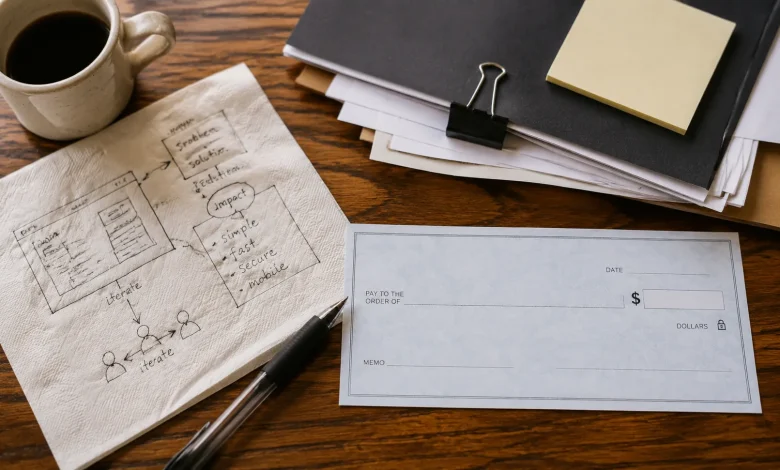
When people say “napkin sketch,” they usually mean it as a compliment a shorthand for raw, unfiltered conviction. But here’s the thing about napkins: anyone can scribble on one. What separates a fundable pre-seed story from a vague hope is specificity of insight.
Take the early days of Airbnb. Before there was a platform, before there were hosts or guests or superhosts, there were three guys who couldn’t pay rent and figured they could charge strangers to sleep on air mattresses in their apartment. That’s not a particularly revolutionary idea in isolation. What made it fundable, eventually, was Brian Chesky’s obsession with understanding why travelers were unhappy with hotels and his willingness to keep pushing that insight until it became a business model.
Your napkin sketch needs to communicate the same thing: why you, why now, and why this specific problem is worth solving at scale. Not in a slide deck filled with TAM calculations and competitive matrices, but in the way you talk about it. Pre-seed investors are listening for the texture of your conviction.
Building the Story Before the Deck
Founders spend weeks perfecting pitch decks and maybe 45 minutes rehearsing the actual conversation. That’s backwards.
The deck is a leave-behind. The conversation is the raise. And in a pre-seed context especially, investors are funding a relationship as much as a company. They’re betting they’ll want to spend the next seven to ten years working alongside you through things that haven’t happened yet and can’t be predicted.
Start with your narrative before you open a slide template. What’s the origin story of how you encountered this problem? What did you believe before, and what changed? What did you see that made you think the existing solutions were fundamentally broken? These questions aren’t soft or peripheral they’re the load-bearing structure of your pitch.
Once the story feels true and tight when you say it out loud, then build the deck around it. The slides should feel like evidence for the story, not a summary of information.
Who Actually Writes Pre-Seed Checks
The ecosystem has expanded considerably. Pre-seed used to mean friends, family, and a handful of angels who made their money in the last tech cycle. That world still exists, but alongside it you now have dedicated pre-seed funds, rolling funds run by operators, syndicates, and accelerators that hand you capital alongside a program.
Each of these sources comes with a different logic. Angel investors often move fast and require less formal diligence but they may also bring less structured support afterward. Institutional pre-seed funds like Precursor Ventures or Hustle Fund have clearer processes and term sheets but also higher bars for what they consider fundable. Accelerators like Y Combinator or Techstars offer capital plus network plus a cohort experience, which is enormously valuable if you’re a first-time founder who needs the scaffolding.
Knowing which type of investor you’re targeting isn’t just a tactical choice it shapes how you tell your story and what you emphasize. An angel who made money in SaaS will respond differently to the same pitch than a thematic fund focused on climate or fintech.
The Warm Intro Problem (And the Way Around It)
Here’s an uncomfortable truth: most pre-seed checks still get written after a warm introduction. The industry loves to talk about democratization, but the reality is that cold outreach conversion rates are brutal. A well-connected founder with a mediocre idea will often out-raise a brilliant founder operating in isolation.
Which means your fundraising surface area matters as much as your pitch itself.
The smart play isn’t to spend three months trying to get a direct intro to a partner at a top fund. It’s to build genuine relationships with founders who are one step ahead of you people who raised18 months ago, closed their round, and are now navigating their seed. Those people remember what the pre-seed grind felt like. They’re more likely to make a warm intro to an investor who backed them, and a founder referral carries real weight at this stage.
The secondary play is going through the portfolio. If a fund has invested in companies you admire, reach out to those founders directly and ask for their honest read on the investor. You learn something real, and if the conversation goes well, you might earn a mention.
Terms, SAFEs, and What Not to Overthink
Most pre-seed rounds are done on SAFEs now Simple Agreements for Future Equity. They’ve become the default instrument for good reason: they’re fast, they’re clean, and they defer the complicated valuation conversation until the seed round when there’s more data to anchor it.
The typical pre-seed SAFE will have a valuation cap somewhere between $4M and $15M depending on geography, team pedigree, and how competitive the round is. Some will also include a discount rate, usually 15-20%, which gives early investors a lower price per share when the SAFE converts.
Founders get tangled up in obsessing over their cap. The more important question is whether the cap reflects what your round actually enables you to build. If you’re raising $500K on a $10M cap, you should be able to answer: what does $500K get us, and why is hitting that milestone worth 5% of the company? That math should feel tight, not aspirational.
When You Don’t Get the Check
Rejection at pre-seed is common and often meaningless. The signal-to-noise ratio in investor feedback is low. Some will pass because of genuine concerns about the market or the team. Others will pass because they already funded something adjacent and didn’t tell you. A few will pass because your meeting was on a Thursday after a bad portfolio company call and timing is quietly real.
What you’re actually looking for isn’t a yes on the first try. You’re looking for a pattern. If ten investors independently raise the same objection, that’s a signal worth examining. If the feedback is scattered and incoherent, keep going.
The founders who close their pre-seed rounds are rarely the ones who pitched the fewest people. They’re the ones who stayed in motion long enough to find the investors who saw what they saw and had the self-awareness to keep refining their story along the way.
The napkin sketch only becomes a company when someone else believes in it too. That moment, the first check, is less a validation of your idea than a confirmation that you survived the doubt long enough to find your people.