Your Fancy Digital Tech Stack is Actually Making You Less Productive
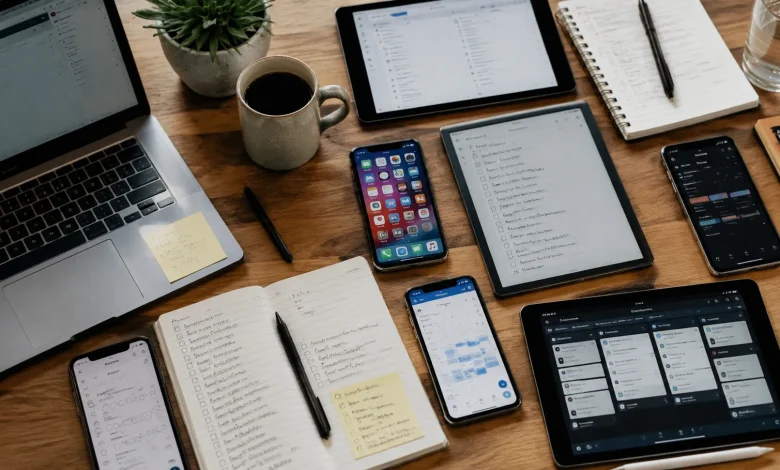
There’s a particular kind of person who has a different app for everything. One for tasks, one for notes, one for habit tracking, one for time blocking, one for project management, one for journaling, and just to make sure nothing slips through the cracks a second task app “for work stuff.” Their home screen looks like a productivity expo. Their browser has fourteen pinned tabs, each representing a system they swore would finally fix things.
And yet. They’re constantly behind. Constantly switching contexts. Constantly feeling like the tools themselves have become the job.
This isn’t a fringe phenomenon. It’s arguably the defining productivity failure of the 2020s.
The Promise That Got Us Here
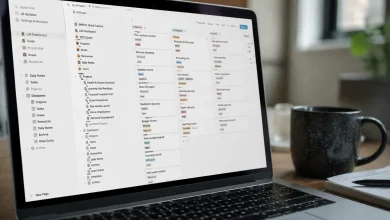
The pitch for productivity software has always been compelling because it speaks directly to anxiety. Every new app promises to eliminate the chaos to be the last tool you’ll ever need, the one that finally externalizes your overwhelm into something clean and manageable. Notion arrived and told us we could build our second brain. Obsidian showed us the beauty of linked thinking. Linear made project management feel like art. And they’re all genuinely good pieces of software. That’s the tricky part.
The problem was never the quality of the tools. The problem is what happens when you stack them.
Cognitive scientists have a term for what occurs when you’re managing multiple systems simultaneously: task-switching cost. Every time your brain has to shift context from one app to another, from one organizational logic to another it pays a tax. That tax is small per instance, maybe a few seconds of mental reorientation. But multiply it across a day of toggling between Slack, Notion, Linear, Todoist, Google Calendar, and a Figma board, and you’ve quietly hemorrhaged an hour or two of deep focus without a single obvious interruption to point to.
Gloria Mark, a researcher at UC Irvine who has spent decades studying attention in the workplace, found that after a distraction it takes an average of 23 minutes to return to the original task at full cognitive capacity. The insidious thing about a fragmented tech stack is that it manufactures micro-distractions constantly, in the guise of being organized.
When Organization Becomes the Work
Here’s where it gets philosophically uncomfortable: most productivity tools are optimized for the feeling of productivity, not the output of it.
Dragging a card from “In Progress” to “Done” on a Kanban board releases a small dopamine hit. Checking off a task in a satisfying app feels like progress. Reorganizing your Notion workspace tweaking databases, adjusting views, adding new properties can consume an entire afternoon and produce absolutely nothing of value. And yet it feels productive because you were engaged in something that looked like work.
This is what Cal Newport has called “pseudo-work”: activity that mimics the texture of productive effort without advancing anything real. The tragedy is that digital tools have industrialized pseudo-work. They’ve given it an interface.
A writer I know spent three weeks designing the perfect content calendar in Airtable. She color-coded by content type, linked records to a separate research database, embedded her editorial calendar into a Notion master dashboard, and set up Zapier automations to surface due dates in Slack. By the time she finished, she had a beautiful system and she hadn’t written a single article. The calendar was full of things she intended to write. The act of building the infrastructure had replaced the act of doing the work.
She is not unusual. She is, in fact, the norm in a culture that confuses system design with execution.
The Paradox of Optionality
There’s a reason that some of the most prolific creators in history worked with remarkably constrained tools. Cormac McCarthy wrote on a typewriter for decades the same one, a $50 Olivetti until it wore out. He recently sold it at auction for over $250,000. He didn’t switch to a distraction-free writing app. He didn’t explore whether Ulysses or Scrivener might better suit his workflow. He had a machine, and he used it to write books that will outlast most software companies.
That’s an extreme example, but the principle scales. Constraint isn’t a limitation to be overcome it’s often the condition under which depth becomes possible. When you have too many tools, you spend cognitive energy choosing between them. Which app does this thought belong in? Does this project warrant its own Notion page or does it live in Linear? Should I write this idea in Bear, Obsidian, or just type it into the notes field on my iPhone? These are decisions that feel small but accumulate into a constant, low-grade tax on mental energy.
Barry Schwartz described this in his work on the paradox of choice: more options create more anxiety, not more satisfaction. When there are a hundred ways to capture a task, you’re perpetually second-guessing whether you used the right one. That uncertainty is corrosive to the clear-minded state that serious work requires.
The Status Layer Nobody Talks About
There’s also something else going on, something people are less eager to admit. Having a sophisticated tech stack has become a form of identity performance. Sharing your setup your Notion workspace screenshot, your Arc browser layout, your custom Alfred workflows is now a subgenre of content creation with its own audience. Productivity Twitter exists. Productivity YouTube has channels with millions of subscribers. The aesthetic of being organized has cultural cachet.
This status layer quietly distorts your relationship with tools. You adopt them not purely because they solve a problem but because they signal a certain kind of seriousness, a certain belonging to a tribe of thoughtful professionals. The app becomes a prop in the story you’re telling about yourself.
Which means when the app fails to deliver when Notion’s flexibility becomes its own source of paralysis, when the Roam Research learning curve never pays off you don’t abandon it. You blame your implementation. You watch more YouTube tutorials. You rebuild the system. Because admitting the tool doesn’t work for you means admitting something about your own narrative.
This is a trap that genuinely smart people fall into because it’s dressed in the language of self-improvement.
What Actually Works Is Boring
The evidence, across research and the habits of prolific people, consistently points toward simplicity. A single trusted capture system. Ruthless reduction of the number of places information lives. Long, uninterrupted blocks of time where exactly one thing is happening.
David Allen’s Getting Things Done is thirty years old, originally designed for paper and manila folders. Writers who swear by their process tend to have almost comically minimal setups a text editor, a wordcount goal, a time to sit down and a time to stop. Surgeons don’t debate whether to use a different scalpel mid-operation. They develop mastery of a limited instrument set and focus entirely on the patient.
The version of productivity that sells that gets the YouTube views and the affiliate links requires novelty. A new system every quarter. A better app. An updated workflow. It needs you to stay in the market for solutions. But the version that actually produces things looks a lot like commitment to something boring: the same tool, the same time, the same physical or digital space, day after day.
Less friction isn’t always a feature. Sometimes friction is the signal that you’re about to do something real.
You don’t need a better app. You need to open the one you have and do the work.