The Lazy Person’s Guide to a Perfectly Automated Bedroom
Laziness Has a Bad Reputation It Doesn’t Deserve
There’s a particular kind of person who spends three hours researching how to automate their morning alarm so they don’t have to reach across the nightstand. Most people would call that person lazy. I’d call them efficient. The distinction matters, because the entire philosophy behind a smart bedroom rests on a simple premise: the less friction between you and rest, the better your life gets.
We’ve been conditioned to believe that effort equals virtue. That struggling with a tangled lamp cord at midnight or fumbling for the thermostat at 3am somehow builds character. It doesn’t. What it builds is interrupted sleep, low-grade irritation, and a bedroom that feels like a chore rather than a sanctuary. Automation isn’t about being too precious to flip a light switch. It’s about recognizing that your bedroom is the one room in your home that should work entirely around your biology, not your to-do list.
Start With Lighting, Because Nothing Else Matters More
Ask anyone who’s accidentally hit a bright overhead light at midnight and you’ll get the same visceral reaction that sharp, disorienting blast that takes fifteen minutes to recover from. Light is the single most powerful signal your brain receives about whether it’s time to be awake or asleep. Getting it wrong is genuinely costly.
Smart bulbs like the Philips Hue or LIFX line allow you to program gradual dimming schedules tied to your actual sleep routine. The idea isn’t novelty. It’s physiology. As evening progresses, you want your bedroom light to shift from cool, blue-toned whites toward warmer amber tones. That transition mimics sunset and triggers melatonin production in a way that your bathroom’s fluorescent tube never will.
The laziness angle here is real: once it’s set up, you do nothing. The lights dim on their own. They turn off when you tell your phone goodnight. In the morning, if you’re someone who struggles with dark winter wake-ups, a gradual sunrise simulation can make the difference between hauling yourself out of bed withresentment and waking up because your body actually thinks the sun came up. This is not a luxury feature. For anyone with seasonal mood shifts or a difficult morning schedule, it’s closer to medicine.
The Climate Control Argument Nobody’s Making Loudly Enough
Sleep research is fairly unanimous on one point that most people ignore completely: the optimal bedroom temperature for deep sleep is somewhere between 65 and 68 degrees Fahrenheit. Your body needs to drop its core temperature to initiate and maintain the deeper stages of sleep. A room that’s too warm disrupts that process at a level you often won’t consciously notice you’ll just wake up feeling like you didn’t really sleep.
Smart thermostats like the Ecobee or Nest learn your schedule and can be programmed to drop the bedroom temperature automatically around your bedtime window. But the more interesting development in recent years is bed-level climate control. Products like the Eight Sleep Pod or BedJet work by running temperature-controlled air or water directly through your mattress cover. Your partner runs hot, you run cold you each set your own side. No more negotiating over the thermostat at 11pm. No more waking up because someone threw off the covers.
The laziness win here is profound. You stop thinking about temperature entirely. The bed is exactly right when you get in. That decision fatigue you didn’t even realize you were carrying just disappears.
Sound, Silence, and the White Noise Question
City noise is a problem. So is a partner who snores, a dog who occasionally loses its mind at 2am, or neighbors with enthusiastic late-night commitments to their television. Sound masking has been around for decades, but the smart home era made it significantly more flexible.
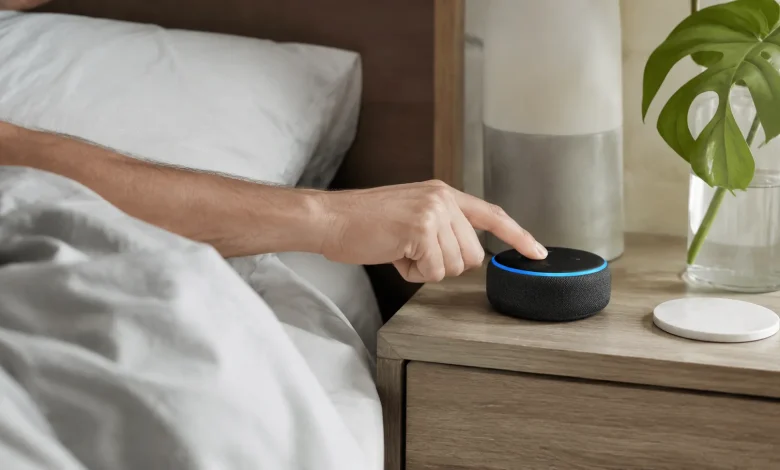
A device like the Hatch Restore or even a simple smart speaker running a white noise routine can be integrated directly into your bedtime scene. You press one button or say one phrase and the lights dim, the thermostat adjusts, and a steady low hum fills the room. That’s a scene, in smart home terminology. A single trigger that sets multiple variables simultaneously.
The more sophisticated version of this is using something like a Lutron Caseta dimmer tied to a bedside button. One tap at the start of your wind-down routine, one tap when you’re ready to sleep, one tap if you get up in the night each mapped to a different configuration of light and sound. You’re not fumbling with three different apps. You’re not hunting for a lamp switch. The room responds to a single, simple gesture.
Voice Control Versus Automation: Knowing the Difference
There’s a trap that catches a lot of people early in the smart home process. They set up Alexa or Google Home, they get excited about telling the lights to turn off, and they stop there. That’s voice control. That’s not automation. The distinction is important because true automation means the room does things without you asking.
Voice control still requires you to remember to ask. Automation requires nothing. The lights dim because it’s 9:45pm. The temperature drops because your phone’s sleep tracking app detected you’re going to bed. The white noise starts because the motion sensor at your bedroom door registered you walking in for the last time that evening.
Building actual automation requires a hub something like a SmartThings or Home Assistant setup or a platform that supports conditional logic. Apple Home has improved considerably with its automation capabilities. Google Home has its routines. Amazon Alexa has routines as well, though they can be finicky. The point is that these tools exist, they’re increasingly accessible, and the setup investment is a one-time cost that pays off every single night afterward.
The Devices That Sound Gimmicky Until You Have Them
Smart blinds get dismissed as an absurd luxury until you’ve experienced waking up at 6am to a summer sunrise that your curtains did nothing to stop. Motorized shades from companies like Lutron Serena or IKEA’s FYRTUR line connect to your smart home system and can be programmed to close at sunset and open gradually in the morning as part of your wake-up routine. The IKEA option in particular has gotten affordable enough that the “that’s a rich person thing” objection has largely expired.
Smart plugs deserve a mention because they’re the least glamorous and most immediately useful entry point into bedroom automation. Any lamp you already own becomes a smart lamp. Your phone charger can be put on a schedule. Your white noise machine can be integrated into scenes without buying a purpose-built smart device. A four-pack of good smart plugs costs less than dinner out and immediately expands what’s possible without replacing anything.
The under-mattress sleep trackers like Withings Sleep or the older version of Eight Sleep’s sensor pad provide data about your actual sleep architecture without requiring you to wear anything. The information feeds back into automations if your deep sleep phase is consistently short, you can test whether adjusting your temperature schedule or your lighting dim-down time makes a measurable difference. That feedback loop is where the automation stops being a gadget and starts being a genuine tool.
One Room, One Rule
The bedroom has one job. It exists to support sleep, recovery, and the transition between the demands of the day and the reset that comes with night. Every decision you make about what technology goes in there should be evaluated against that single criterion.
The automated bedroom isn’t about filling a room with devices. It’s about removing every small obstacle the too-bright light, the wrong temperature, the noise you can’t control, the decision fatigue of managing variables manually until the room itself becomes effortless. Until getting into bed feels like the environment is already waiting for you, already set exactly right, without you having to ask.
That’s not laziness. That’s just knowing what the room is for.