Wired vs. Wireless Gaming Gear: Has Latency Finally Been Defeated?
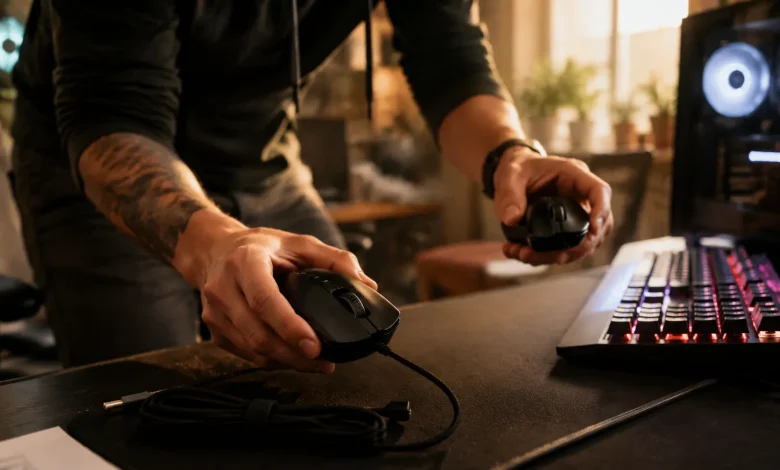
There’s a ritual familiar to any serious gamer who came up in the early 2000s: before a tournament, before a ranked session, before anything that actually mattered, you unplugged the wireless receiver and reached for the corded mouse. It wasn’t superstition. It was physics. Wireless meant lag, and lag meant losing. That was the deal, and everyone knew it.
Two decades later, that deal is being renegotiated loudly, and with some genuinely impressive engineering behind it. But before we declare wireless the outright winner, it’s worth understanding what we’re actually measuring, what the industry changed to get here, and where the argument still has teeth.
The Latency Problem, Properly Defined
Most conversations about input lag collapse several distinct things into one vague complaint. When a gamer says “wireless feels slow,” they’re usually describing a chain of delays: the time it takes for a click or movement to register on the device, transmit to the receiver, get processed by the system, and finally render on screen. Total system latency. Not just the wireless hop.
For years, that wireless hop was genuinely costly. Early2.4 GHz gaming peripherals operated on shared radio frequencies cluttered with Wi-Fi traffic, Bluetooth signals, and interference from neighboring devices. Round-trip latency on budget wireless mice from 2010 could sit anywhere from 8 to 16 milliseconds above their wired equivalents not catastrophic in casual play, but in a game where a frame at 240 Hz lasts just 4.1 milliseconds, that gap is enormous.
The turning point wasn’t a single product. It was a shift in how manufacturers approached the radio layer entirely.
What Actually Changed in the Engineering
Logitech’s LIGHTSPEED technology, Razer’s HyperSpeed, SteelSeries’ Quantum Wireless these platforms share a common architectural philosophy. Instead of relying on generic 2.4 GHz protocols, they use proprietary low-latency radio designs with dedicated USB receivers that handle signal prioritization at the hardware level. They poll at 1000 Hz, the same rate as wired mice. Some recent flagship devices have pushed to 2000 Hz, even 8000 Hz, territory that was unimaginable for wireless just five years ago.
The numbers now sit in a range that should, by any reasonable measure, settle the argument. Modern high-end wireless mice like the Logitech G Pro X Superlight 2 or the Razer DeathAdder V3 HyperSpeed achieve round-trip latency figures between 0.8 and 1.2 milliseconds in controlled lab conditions. Wired mice at 1000 Hz polling typically clock in around 0.5 to 1 millisecond. The gap has narrowed to margins that are, for most intents, indistinguishable to human perception.
But here’s the thing about lab conditions: they’re not your desk.
The Real-World Gap That Benchmarks Don’t Capture
A clean anechoic test chamber with a dedicated receiver plugged directly into a USB3.0 port tells one story. A gaming setup with a 2.4 GHz router three feet away, a wireless headset on the same frequency band, a Bluetooth controller for a console nearby, and a USB hub daisy-chaining half a dozen peripherals tells a different one. Radio frequency congestion is real, and while modern wireless gaming gear handles it better than ever through adaptive frequency hopping and channel selection, it doesn’t make the problem disappear.
This is where wired still holds a quiet, principled advantage. A USB connection doesn’t care about your neighbor’s Wi-Fi. It doesn’t care that you’re in a hotel room surrounded by a dozen overlapping networks. The signal path is deterministic in a way that radio simply cannot be, and for players competing at the very top of precision-dependent titles Counter-Strike 2, Valorant, Quake Champions that determinism still matters.
It’s less about average latency and more about consistency. A wireless connection that averages 1millisecond but occasionally spikes to 4 or 5 milliseconds during a crowded radio environment creates micro-inconsistencies that skilled players can feel even if they can’t name them. Wired removes that variable entirely.
The Headset Divide Is Wider Than the Mouse Debate
Controllers and mice dominate the latency conversation, but wireless audio tells a genuinely messier story. Audio latency has different perceptual thresholds than input latency the human ear is surprisingly tolerant of minor delays in ambient sound, but directional audio cues in competitive gaming are a different matter. Hearing a footstep 15 milliseconds late isn’t an abstract statistical disadvantage; it’s a dead player.
Bluetooth audio, even with aptX Low Latency codecs, typically adds 30 to 100 milliseconds of delay depending on the device and codec negotiation. Most serious gaming headsets avoid Bluetooth for this reason, using their own 2.4 GHz wireless implementations instead. Products like the SteelSeries Arctis Nova Pro Wireless or the HyperX Cloud III Wireless use dedicated USB dongles and proprietary protocols that pull audio latency down to the10to 20 millisecond range.
That’s better. But it’s not wired. A standard USB or3.5mm analog connection delivers audio with effectively zero protocol-induced latency, bounded only by your audio interface and drivers. For esports players who rely on spatial audio as a gameplay mechanic, that margin still justifies the cord.
Where Wireless Has Already Won
None of this should be read as a defense of cords for their own sake. For the vast majority of players and even for plenty of professionals wireless has crossed into territory where the practical benefits far outweigh the remaining technicalcaveats.
Freedom of movement matters. Battery life on flagship wireless mice now routinely exceeds 70 hours, and some models push past 100 hours. The Superlight 2 runs for roughly 95 hours on a charge. The anxiety of a dying peripheral mid-session, once a genuine objection, has become a non-issue for anyone who charges overnight. And the physical ergonomic relief of not managing a cable no snagging on mouse pads, no drag affecting micro-movements is a real, if underappreciated, performance factor. Several professional players have noted that removing cable drag actually improved their tracking consistency, not because latency changed, but because the mechanical resistance was gone.
Controllers settled this argument years ago on the console side. No professional console player reaches for a wired pad in2025unless they’re forced to by rules or platform constraints. The latency profile of something like the Xbox Wireless Controller or the DualSense is good enough that cable management became the bigger performance variable.
The Honest Answer
So has latency been defeated? Technically, almost. Practically, for most people, yes.
The honest framing is this: wireless gaming peripherals have become good enough that the remaining latency delta is smaller than many other variables in your system your monitor’s response time, your CPU’s frame scheduling, your own reaction time on a given day. Chasing wired connections in 2025 because of a theoretical0.3 millisecond advantage while running a 144Hz monitor is a bit like installing racing tires on a car and forgetting to check the alignment.
But “almost” and “most people” are doing a lot of work in that answer. If you’re playing at the absolute ceiling of competitive precision gaming, if RF interference in your environment is significant, or if you’re running audio through Bluetooth rather than a dedicated wireless protocol, the wired option still has an honest argument to make.
The cord isn’t dead. It’s just no longer the default answer to a question that used to have only one.