How Short-Form Video Rewired the Consumer Buying Journey
The Old Map No Longer Works
For decades, marketers operated with a fairly reliable mental model of how people buy things. Awareness led to consideration, consideration led to intent, and intent eventually, with the right nudge tipped into purchase. The funnel was neat. It was linear. It rewarded patience and brand-building. Big ad budgets dominated the top, retargeting campaigns mopped up stragglers at the bottom, and the whole system hummed along with a kind of industrial predictability.
Then came the scroll.
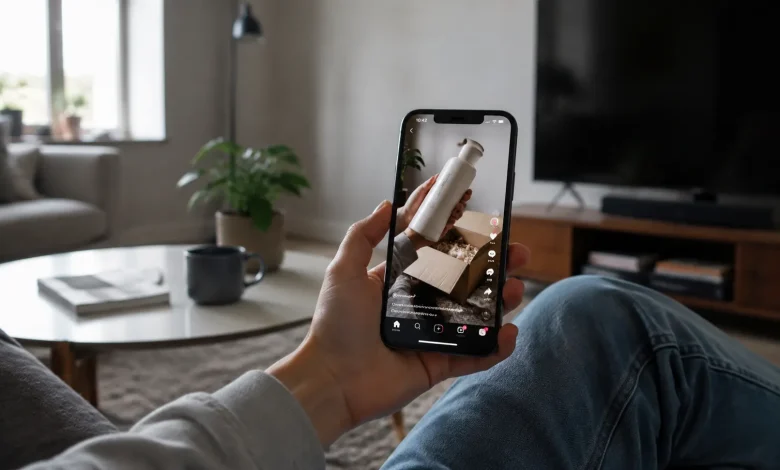
TikTok, Instagram Reels, YouTube Shorts call them what you want, the mechanics are essentially the same. An algorithm surfaces a fifteen-second clip. You didn’t search for it. You weren’t in buying mode. You were killing time between meetings or lying in bed at 11 p.m. with no particular intention at all. And yet, thirty seconds later, you’ve tapped through to a product page. Sometimes you buy immediately. Sometimes the product lodges itself in your mind like a song you can’t shake, and you find yourself purchasing it three days later while convinced it was entirely your own idea.
That is not the old funnel. That is something else entirely.
Discovery Has Gone Native
The most fundamental shift isn’t about speed or attention spans, though both matter. It’s about where discovery now lives. For most of consumer history, product discovery happened inside explicitly commercial contexts a store aisle, a catalog, a search results page. You went looking. The product waited.
Short-form video collapsed that separation. Discovery is now embedded inside entertainment, inside social behavior, inside the passive rhythms of daily life. A skincare product doesn’t get discovered because someone searched “best moisturizer for dry skin.” It gets discovered because a creator in Ohio with400,000 followers held a bottle up to the camera, laughed, and said “I don’t know why this works but my skin has never looked better in my life.”
That sentence unscripted, slightly chaotic, weirdly specific does more persuasive work than most brand campaigns. And it does it without ever feeling like persuasion.
This is what marketers mean when they talk about native discovery, though the phrase barely captures the psychological texture of it. The consumer isn’t on guard. They’re not evaluating. They’re just watching. Which means the usual defenses skepticism about ad claims, fatigue from polished messaging simply don’t activate in the same way.
The Compression of the Consideration Phase
Traditional purchase journeys had breathing room. There was time between awareness and action, and brands used that time to layer in messaging, build associations, handle objections. That architecture assumed a consumer who would deliberate.
Short-form video operates on a different psychology. The content itself does the consideration work in real time. A good product video isn’t just introducing the item it’s preemptively answering questions, showing the product in context, handling objections through demonstration rather than copy. By the time the creator has shown the before-and-after, done the live unboxing, pointed out the texture or the sizing quirk or the way the clasp works, the viewer has mentally simulated ownership.
That simulation is the consideration phase. It’s just happening in forty seconds instead of four days.
Amazon understood this years ago with video on product pages, but the format was still transactional something you watched because you were already shopping. The difference with short-form is the entry point. You arrive through entertainment. The consideration happens inside the content. And the handoff to purchase can be nearly frictionless a link in bio, a pinned comment, a shopping tab that lives inside the app itself.
TikTok Shop made this chain explicit. The entire ecosystem content, community, commerce is designed to blur every boundary between watching and buying. Whether that’s good for consumers is a separate conversation. What’s undeniable is that it works.
Trust Has a New Architecture
One reason the old funnel held up for so long was that brand trust accumulated slowly through repeated exposure. See the logo enough times in the right contexts, absorb enough polished messaging, and the brand earns a kind of ambient credibility. It was expensive to build and expensive to maintain, which is why incumbents had structural advantages.
Short-form video democratized the trust layer, and it did so by routing around brand authority entirely.
A stranger on the internet now carries more persuasive weight than a full-page ad, not because audiences are naive but because the stranger operates in a register that feels honest. The imperfect lighting, the real apartment in the background, the slight awkwardness of holding a product to a phone camera all of it reads as authentic in a way that a studio shoot simply cannot replicate. The signal of production quality has inverted. High production now reads as suspicious. Lo-fi reads as real.
This has created a new trust architecture built on specificity and community rather than scale and repetition. A micro-influencer with 12,000 followers who reviews running shoes every week has earned genuine authority in that niche. Their recommendation carries weight proportional to that specificity, and often more than a celebrity partnership that the audience knows is paid.
Brands that understood this early particularly in beauty, fitness, and food restructured their entire marketing approach around seeding product with creators rather than buying traditional media. The results, in many cases, made the old model look quaint.
The Attention Economy’s Unexpected Casualty
There’s a counterintuitive consequence worth sitting with: short-form video has made impulse buying more sophisticated, not less.
That sounds like a contradiction. The assumption is that faster discovery and faster purchase paths produce more reckless decisions people buying things on a whim because a video caught them in a weak moment. Sometimes that’s exactly what happens. But something more interesting is also occurring.
Because social video is inherently interactive, the comment section has become a crowdsourced due-diligence tool. Watch any product go viral on TikTok and within hours the comments are full of people who’ve actually bought it reporting back on sizing, durability, whether the color looks different in person, whether customer service responded when something went wrong. It’s a real-time review system that operates at a speed no traditional review platform can match.
The consumer who buys through short-form video is often better informed about specific product realities than the consumer who spent twenty minutes reading static reviews. The format generates faster feedback loops, surfaces edge cases quickly, and punishes brands that can’t deliver on what the creator promised.
In that sense, the shortening of the buying journey hasn’t made consumers easier to fool. It’s made product quality harder to hide.
What Comes After Virality
The lingering challenge for brands isn’t figuring out how to go viral most have figured out that virality is neither predictable nor sustainable as a strategy. The harder problem is what happens in the space between discovery and loyalty.
Short-form video is extraordinary at the moment of ignition. It’s less naturally suited to the slow work of retention. A customer who found you through a thirty-second clip has a shallower initial relationship with the brand than one who spent time reading, comparing, and deliberately choosing. The emotional texture is different. The anchoring is thinner.
Brands navigating this well have learned to treat the short-form discovery moment as the beginning of a longer relationship, not the end of the transaction. The video gets the customer in the door. Email, community, product quality, and post-purchase experience have to do the rest. The funnel didn’t disappear it just got a new and very fast front door.
What’s changed permanently is the logic of capture. Attention is now earned inside entertainment, trust is built through specificity rather than scale, and the consumer’s decision-making process has been compressed, socialized, and embedded into the content itself. Any brand still mapping its customer journey onto a linear funnel is navigating with an outdated instrument accurate enough in quiet water, but unreliable once the current picks up.